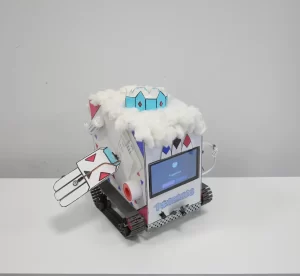
A robot that fails to follow its programmed line accurately, a sensor that provides incorrect data, or a mechanical arm that stops midway through a movement are all real learning experiences. This is precisely where robotics laboratories for students become valuable: not as demonstration spaces, but as environments where errors are analyzed, code is refined, and ideas are transformed into functional solutions.
For students pursuing programming, Artificial Intelligence, engineering, or automation, a laboratory is not simply an addition to the academic curriculum. It is the environment where theory is tested using real equipment, data, and practical constraints. This experience creates a clear distinction between understanding concepts and having the ability to build systems that actually work.
Why Robotics Should Be Learned Through Practice
Robotics is an interdisciplinary field. Even a simple project may require programming, electronics, mechanics, mathematics, signal processing, and decision-making logic. When these subjects are taught separately, students may understand formulas and syntax without necessarily understanding how they relate to one another.
In a laboratory, these connections become tangible. A small change in the code can affect motor speed. Sensor positioning can determine whether a robot detects an obstacle or ignores it. An Artificial Intelligence model may produce good results on a computer but require recalibration when used in a physical environment involving light, noise, and movement.
This is an important professional lesson: technology is not evaluated solely by its concept, but by its performance under real-world conditions. Students who understand this early develop analytical skills, testing discipline, and the confidence to work on complex projects.
What Should Robotics Laboratories for Students Offer?
A quality laboratory is not defined solely by the number of devices it contains. Equipment is important, but academic value is created when it is combined with a working methodology, scientific mentorship, and clear learning objectives.
First, students should have access to platforms that allow them to start with the basics and gradually progress toward more advanced systems. Microcontrollers, sensors, actuators, and mobile robots are useful tools because they demonstrate the connection between digital commands and physical actions. For more advanced students, computer vision systems, robotic arms, simulation environments, and data collection equipment create opportunities for applied research.
Second, laboratories should provide time for experimentation and improvement. Completing an assignment solely for a grade is not enough. A project becomes valuable when students document the problem, test alternatives, interpret results, and explain why one solution worked better than another.
Third, teamwork is essential. In the technology industry, robotic products are not developed by a single professional profile. A team may require a software developer, an electronics engineer, a data specialist, and a project manager. A laboratory is the right place to learn technical communication, responsibility sharing, and deadline management.
From Academic Exercises to Projects with Real Impact
Robotics projects become more valuable when they address problems that students and their communities can recognize. An air quality monitoring system, a robot that navigates autonomously within a controlled environment, an energy management solution, or a logistics assistance prototype can all serve as starting points.
The goal is not to turn every student project immediately into a market-ready product. Instead, the objective is to develop the right mindset: identify a need, establish functional requirements, build a prototype, and measure the results. This approach moves robotics beyond the idea of an isolated experiment and places it within the broader context of innovation.
For example, a mobile robot may begin as an assignment focused on sensor programming. In the next stage, it may use obstacle avoidance algorithms. Later, the team can introduce computer vision or an AI-based decision-making module. Each new step requires deeper knowledge but builds upon a result that has already been tested.
Artificial Intelligence Makes Robotics More Challenging
Traditional robotics relies on predefined rules: if a sensor detects an obstacle, the robot stops or changes direction. Artificial Intelligence introduces another level of functionality: systems can analyze patterns, classify objects, or make decisions based on data.
This does not mean that AI replaces the fundamentals of engineering. On the contrary, it requires a more accurate understanding of them. An object recognition model is not useful if the camera is incorrectly positioned, the training data is insufficient, or the device lacks the processing capacity to run the model in real time.
Students must also learn to understand the limitations of these systems. How accurate are the results? What happens when the data changes? Can the system’s decisions be explained? How is the data collected by the robot protected? These questions prepare young people for a job market that requires not only skilled developers but also responsible professionals.
The Laboratory as a Bridge to Research and Entrepreneurship
An active laboratory can be the beginning of a broader academic journey. A course project can evolve into a graduation thesis, a research paper, participation in a technology competition, or a startup idea. This happens when students have mentors who help them progress from an initial prototype to a technically validated solution.
At Metropolitan Tirana University, the focus on AI, intelligent systems, applied research, and digital incubation places laboratory work within a broader ecosystem. Students are not prepared merely to use existing technologies, but to build, test, and develop ideas that can respond to the needs of the Albanian and regional markets.
However, not every student needs to pursue the same career path. Some may prefer developing industrial automation systems, others may be interested in service robotics, while research-oriented students may focus on perception and decision-making algorithms. Laboratories provide the opportunity to explore these directions before making a career choice.
How to Make the Most of Laboratory Work
The greatest benefits do not come from passively watching a demonstration. They come when students take notes on errors, ask why a solution does not work, and look for ways to improve it. A portfolio containing documented projects, clear code, testing results, and an explanation of each team member’s role carries more weight than a general list of skills.
It is also important to establish connections between laboratory work and the professional world. Projects addressing real-world challenges, mentorship from academics and industry professionals, participation in research initiatives, and public presentations of results develop skills that cannot be measured through examinations alone. They help build the profile of a professional who knows how to communicate ideas, collaborate, and deliver results.
The first step can be simple: choose a problem that interests you, build a small prototype, and measure what happens. In robotics, every unsuccessful test can become valuable knowledge, provided you have the right environment to analyze it and the determination to try again.