A New Milestone for Scientific Research at UMT: Evis Plaku Successfully Completes His PhD in Artificial Intelligence
Metropolitan Tirana University marks an important milestone in scientific research: Evis Plaku becomes the first doctoral candidate to successfully defend his dissertation at the Doctoral School of Artificial Intelligence and Intelligent Systems, with research focused on enhancing the autonomy of mobile robots in complex environments.
Robots are no longer simply programmed systems designed to perform repetitive tasks. They are being developed to adapt to unforeseen situations, avoid obstacles, and navigate safely even in spaces where they interact with people.
However, as their autonomy increases, so does the importance of the challenges that scientific research must address. How can a robot navigate a complex environment safely and efficiently when its planned route becomes blocked and changing circumstances require it to make a new decision?
This is precisely the challenge addressed by Evis Plaku's research, which marks an important achievement for Metropolitan Tirana University and a new milestone in the development of doctoral research in the field of artificial intelligence.
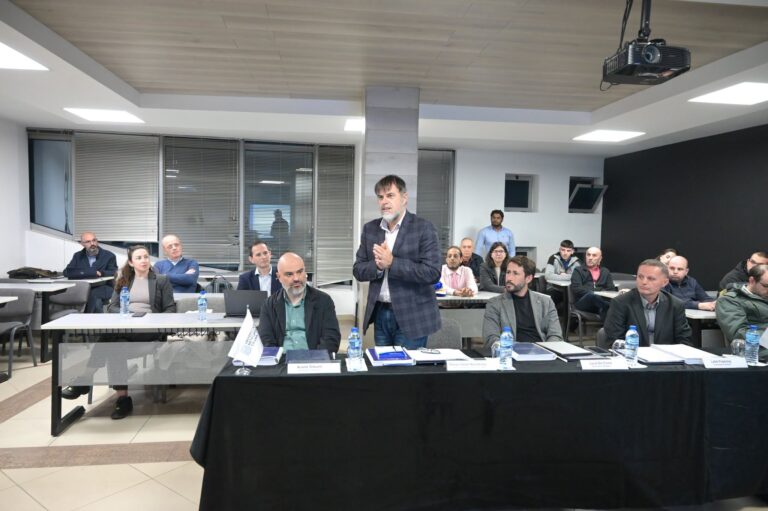
A Dissertation on the Autonomy and Safety of Mobile Robots
Evis Plaku's dissertation, entitled “Enhancing Autonomy of Mobile Robots Operating in Complex Environments,” was completed under the scientific supervision of Prof. Dr. Nikolla Civici, Rector of Metropolitan Tirana University (UMT).
Enhancing Autonomy of Mobile Robots Operating in Complex Environments
Improving the autonomy of mobile robots operating in complex environments.
The research addresses one of the key challenges in modern robotics: developing algorithms that enable robots to navigate complex environments safely and efficiently, maintain a safe distance from obstacles, identify routes to safe areas, and find alternative paths when the planned route can no longer be followed.
To address this challenge, the dissertation proposes a two-stage algorithmic planning architecture. First, a mathematical model of the environment is constructed, incorporating distances from obstacles, safety zones, and alternative routes. The robot then uses this model to generate movements that respect its physical constraints.
By addressing these requirements within a unified framework, the proposed approach aims to deliver safer and faster solutions than existing methods. In this way, the research contributes to the development of robotic systems capable of responding to unforeseen situations with greater autonomy and reliability.
From Scientific Research to Real-World Applications
The significance of this research lies not only in its theoretical and algorithmic contributions but also in its potential applications across various fields. Autonomous robots can help improve logistics processes, autonomous transportation and delivery, agriculture, and rescue operations, where the ability to navigate safely and adapt to obstacles can be essential.
Evis Plaku's research findings have been published in international scientific journals and conference proceedings, demonstrating his commitment to research and his contribution to a field that is becoming increasingly important to technological development.
The value of science lies not only in the knowledge it generates, but also in its ability to transform that knowledge into practical solutions to today's and tomorrow's challenges.
Dissertation Evaluation
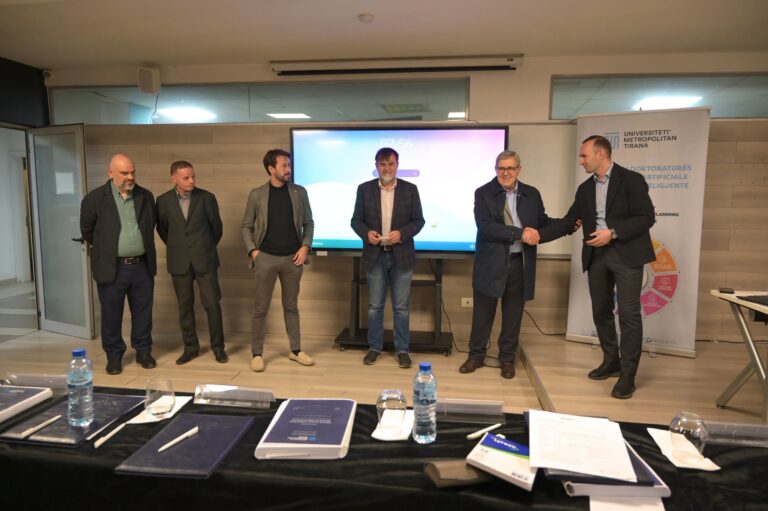
The dissertation defense concluded successfully, with the highest possible evaluation awarded by a jury comprising professors from international academic institutions and Metropolitan Tirana University.
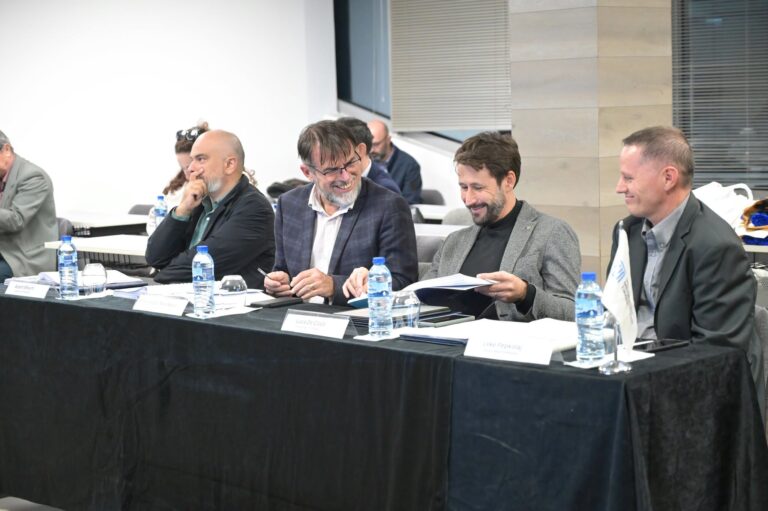
The jury was chaired by Prof. Silviu-Iulian Niculescu, Professor and Research Director at CNRS, affiliated with L2S, CNRS, CentraleSupélec, and Université Paris-Saclay in France.
The jury members included Prof. Hugues Mounier from Université Paris-Saclay, France; Prof. Luca De Cicco from Politecnico di Bari, Italy; and Prof. Lekë Pepkolaj and Prof. Aranit Shkurti from Metropolitan Tirana University, Albania.
The jury's composition, bringing together academic expertise from France, Italy, and Albania, gave the defense an international dimension, placing the scientific merit of the research at the center of the evaluation process.
Advancing Doctoral Research and Academic Standards at UMT
The successful defense of the first dissertation at the Doctoral School of Artificial Intelligence and Intelligent Systems represents an important milestone in the academic journey of Metropolitan Tirana University.
Under the leadership of Prof. Dr. Arben Çela, the Doctoral School places emphasis on the continuous improvement of academic processes, the establishment of rigorous standards, and the preservation of quality in research training. These principles are essential to building a university environment in which research is grounded in scientific rigor, critical thinking, and the production of valuable knowledge.
In a field such as artificial intelligence, where technological and scientific developments are progressing rapidly, training emerging researchers and creating opportunities for high-quality research are integral parts of the university's academic mission.
Beyond the individual achievement, this success marks a starting point for future researchers and a new chapter for doctoral research at UMT.
Every new academic journey is built upon the work of those who dare to explore, ask new questions, and push the boundaries of knowledge.
This achievement marks an important milestone for UMT, reinforcing the university's commitment to advancing scientific research, developing the next generation of researchers, and creating innovative solutions with a meaningful impact on the real world.