A new artificial intelligence architecture that learns from few examples.
Authors: Oriod Malo, Alexandre Xavier Falcão dhe Laurent Najman — IEEE Access
Can an artificial intelligence system learn to recognize new objects after seeing only one or five examples? For humans, this is often a natural ability. For neural networks, which are typically trained on thousands of images, it is an entirely different challenge.
This challenge is known as Few-Shot Learning (FSL). It becomes particularly important in medicine, where labeled images may be scarce, expensive to annotate, or difficult to obtain. Instead of always seeking more data, we can ask: can we improve the way the network itself perceives images?
This is precisely the question addressed by our paper “A Novel Lightweight Multi-Scale Branching Encoder for Few-Shot Image Classification”, accepted for publication in the international journal IEEE Access. It proposes Sum12, a novel convolutional architecture that learns visual features at multiple scales without relying on an excessively complex model.
How Does It Work?
Imagine that you are analyzing an image: a small detail may be decisive, but its meaning also depends on the broader structure surrounding it. Traditional convolutional neural networks do not always combine these levels of information directly.
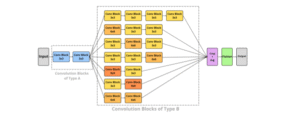
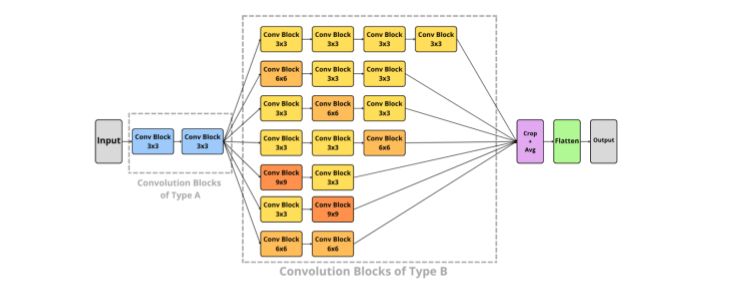
Sum12 uses seven parallel convolutional branches. Each branch processes the same information through a different sequence of filters with sizes of 3×3, 6×6, or 9×9. The rule that connects all branches is simple: the sum of the filter sizes in each sequence is 12. In this way, the network analyzes structures at different scales while maintaining a compact architecture.
Why Does It Matter?
Accuracy improvements are often achieved by building increasingly larger models. Sum12 follows a different approach: using seven parallel branches to combine features at different scales. The architecture was evaluated on 16 datasets: Omniglot, CIFAR-FS, FC100, and miniImageNet for Few-Shot Learning, as well as 12 MedMNIST 2D collections. The comparison with Prototypical Networks was conducted under the same experimental conditions. Here are some of the results:
What About Medical Imaging?
A Step Towards Resource-Constrained Devices
The standard encoder has approximately 1.88 million parameters, while the dilated convolution variant has approximately 0.74 million. After INT8 quantization, the model was reduced to approximately 799 KB and deployed on the STM32 NUCLEO-H753ZI microcontroller. Discrepancies between the results obtained on a computer and those obtained on the microcontroller indicate that this implementation has not yet been functionally validated for Few-Shot classification. Addressing these discrepancies remains a direction for future work.Where Can It Be Applied?
- In visual recognition tasks with only a few labeled images per class.
- In medical image analysis when only limited data is available.
- In the development of compact models for resource-constrained devices.